Heineken's "Clinker" is the best argument yet for why most "AI" activations should actually be sensors
Heineken’s Clinker, launched at Coachella 2026, is a smartband that lights up when two users with similar music streaming histories cheers their cans. It’s sensor-led, passive, and requires no app or screen.
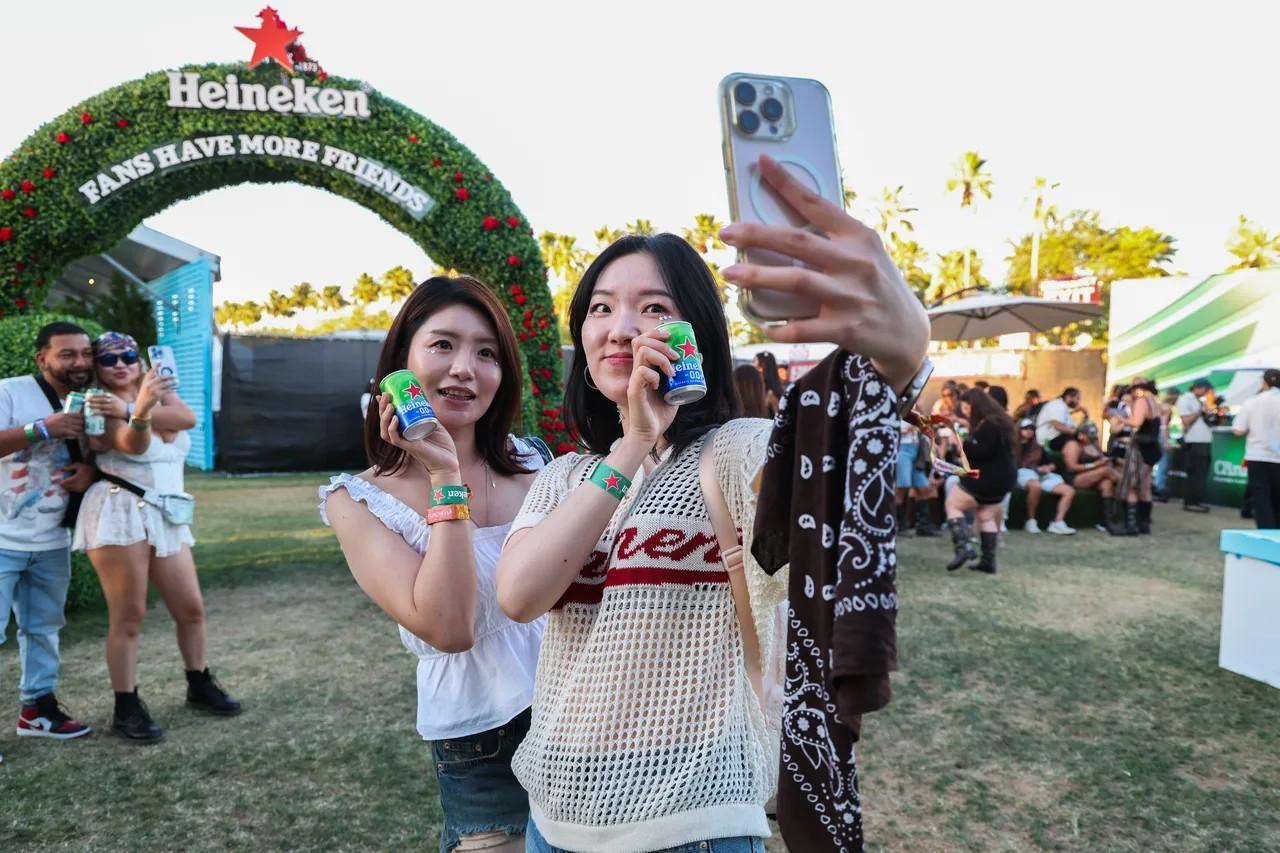
In short: Heineken’s Clinker, launched at Coachella 2026, is a smartband that wraps around a beer can and lights up when two users with similar music streaming histories cheers their cans. It’s sensor-led, passive, and requires no app or screen. For activation teams in 2026, the principle is portable: a sensor that responds to ambient behavior outperforms a screen that demands active engagement, in almost every context.
Photo: Courtesy of Heineken.
Heineken, Coachella’s beer sponsor for 23 consecutive years, launched something at the 2026 festival worth studying carefully. It’s called The Clinker. It’s a smartband that wraps around a Heineken can and syncs with the user’s music streaming data. When two Clinker-wearing strangers cheers their cans, the bands light up if their music tastes match.
That’s it. No app. No screen. No prompt. The technology has exactly one job: turn a cheers into a conversation starter with a stranger.
The Clinker is interesting not because it’s complicated but because it’s restrained. Most “AI activations” fail on the same axis: they ask the user to do too much. The Clinker asks the user to do nothing they weren’t already doing.
Sensors over screens, every time
Walk through Coachella or SXSW in 2026 and the standard tech-led pattern repeats: a screen at the entrance, maybe an AI photo booth, an “interactive moment” where the user types something and gets an output, a QR code funneling to a microsite. These all share a structural problem. They require the user to opt in to a piece of tech that competes for attention with everything else at the event.
The drop-off is brutal. Even the polished versions, like Google’s Gemini photobooth at Coachella, get used by a fraction of the people who walk past, because most people don’t want additional cognitive work at a festival.
The principle, in one line: in 2026, a sensor that responds to ambient behavior will outperform a screen that requires active engagement, in almost every activation context.
A sensor measures something the user is already doing (proximity, sound, motion, touch, RFID) and triggers a response without asking for anything new. A screen demands that the user stop, look, learn, and engage. Heineken understood this. So did Pinterest, whose phone-free zone removed the screen entirely. So did Rivian, whose experience was driving, the thing the user signed up to do anyway.
Photo: Courtesy of Heineken.
What this means for activation work in 2026
The shift from screens to sensors runs through the whole brief-to-build pipeline.
For the creative brief: when a client says “we want to use AI,” the right follow-up is “what behavior is the user already doing that we could detect?” It’s the logic we built our AI DJ booth on: guests were already picking songs at a party, so the AI lives inside a booth they touch, not a screen they queue for.
For the fabrication build: sensors disappear into objects; screens require furniture. A custom-fabricated bar with embedded sensors reads as a bar. A custom-fabricated bar with a screen on it reads as a screen with a bar attached.
For the budget: sensors are usually cheaper than screens, up-front and in operation. Pulling budget from “more screens” and reallocating to “better fabrication around fewer sensors” is almost always the better trade.
For the metric: sensor-led activations generate fewer photos but more talked-about moments. Talked-about lasts. Photographed-once doesn’t.
Photo: Courtesy of Heineken.