Refik Anadol just opened the world's first AI art museum. The fight that followed tells you everything about how to use AI in a brand activation
On April 25, 2026, artist Refik Anadol opened Dataland in downtown Los Angeles, billed as the world’s first museum of AI arts. The opening drew immediate criticism from artists who called AI art “second-rate entertainment.” The debate gives activation teams a useful frame: AI use
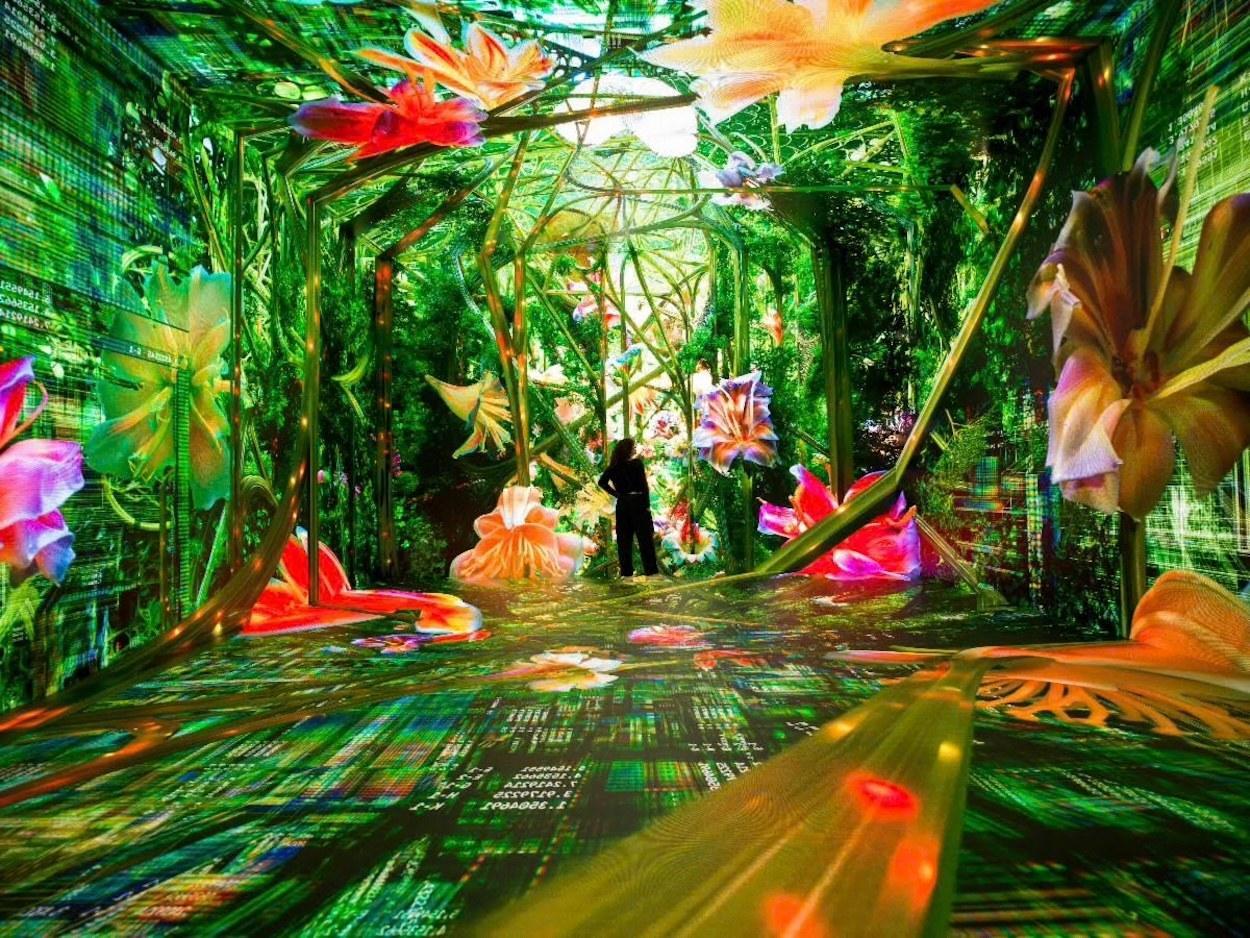
In short: On April 25, 2026, artist Refik Anadol opened Dataland in downtown Los Angeles, billed as the world’s first museum of AI arts. The opening drew immediate criticism from artists who called AI art “second-rate entertainment.” The debate gives activation teams a useful frame: AI used as the visible center of an experience (a screen with a prompt) tends to fail. AI used as a hidden engine inside a fabricated environment tends to succeed.
Photo: Refik Anadol Studio, courtesy of DATALAND.
On April 25, Refik Anadol announced the opening of Dataland, the world’s first museum of AI arts, inside the Frank Gehry-designed Grand LA in downtown Los Angeles. The inaugural exhibition, Machine Dreams: Rainforest, runs on Anadol’s Large Nature Model, a generative system trained on millions of nature images and audio clips from the Smithsonian, London’s Natural History Museum, and Anadol’s own field work with the Yawanawa people of the Amazon.
Within hours, the announcement triggered the loudest version yet of a fight that’s been building for two years. Thomas Brummett, a digital artist with work in the Museum of Fine Arts Houston and the Philadelphia Museum of Art, posted: “Let’s build a museum based on instructions people give to AI and call it art. It’s not and it never will be. At best, it’s just second-rate entertainment.”
That fight matters beyond the gallery, because every activation team in 2026 is being asked some version of the same question: can we use AI in this? Anadol’s project, and the criticism it provoked, is the clearest case study yet on the difference between AI as craft and AI as gimmick.
Two ways to use AI in a physical experience
Option one: AI generates the experience. The visitor stands at a screen, types or speaks a prompt, gets an output, shares it. This is what most brand activations mean by “AI-powered.” Google ran a polished version at Coachella 2026 with its Gemini photobooth. But even the polished ones share a flaw: the AI is the entire experience. Take the AI away and you have a generic photo printer in a tent. That design works while “wow, AI did that” still has currency, and the currency is depleting fast.
Option two: AI is the engine, but the experience is something else. The visitor interacts with a fabricated environment, an installation, an object. The AI works in the background, making the environment respond, evolve, feel alive in a way it couldn’t otherwise. The AI is invisible; the craft is what’s visible.
Dataland sits squarely in option two. You don’t prompt the Rainforest installation. You walk into it. The Large Nature Model generates imagery and sound continuously, but you’re aware of the room, not the model. Brummett’s criticism is aimed at option one. When the AI is hidden inside a piece of craft that humans designed, fabricated, and curated, the way a sculpture is made of metal, the criticism gets harder to hold up.
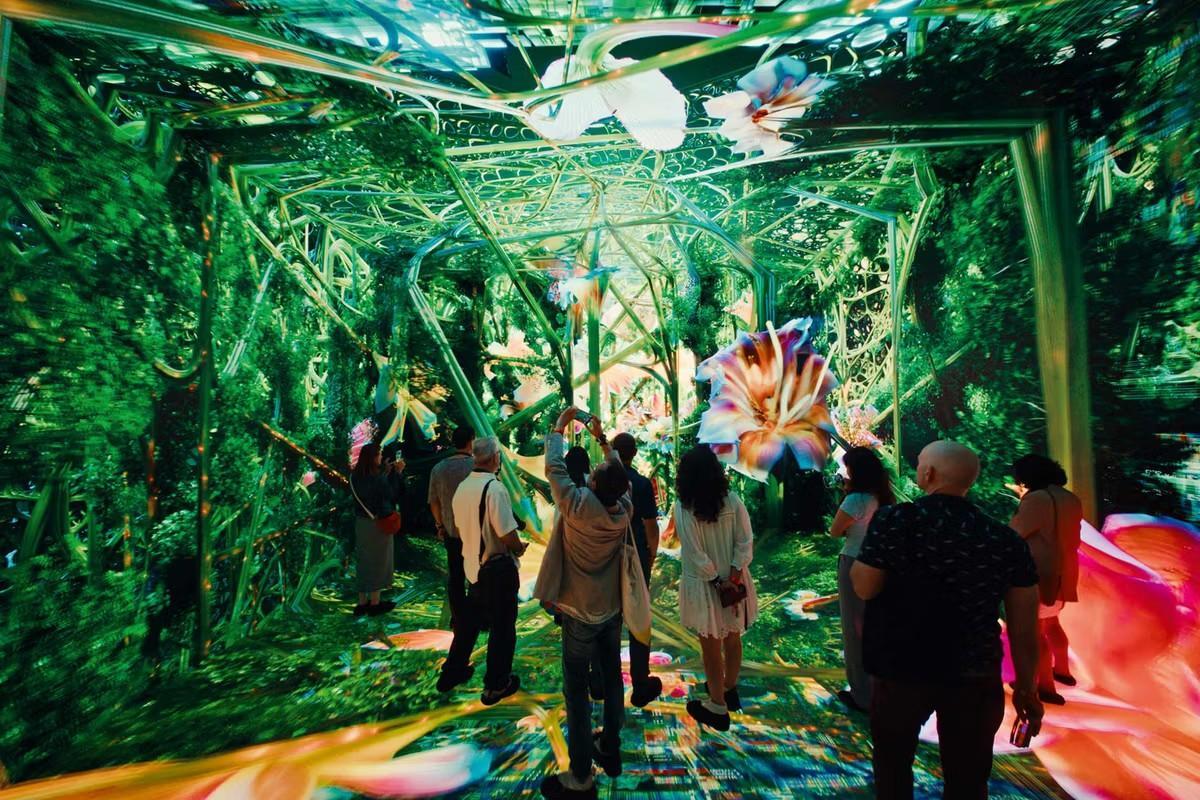
Photo: Refik Anadol Studio, courtesy of DATALAND.
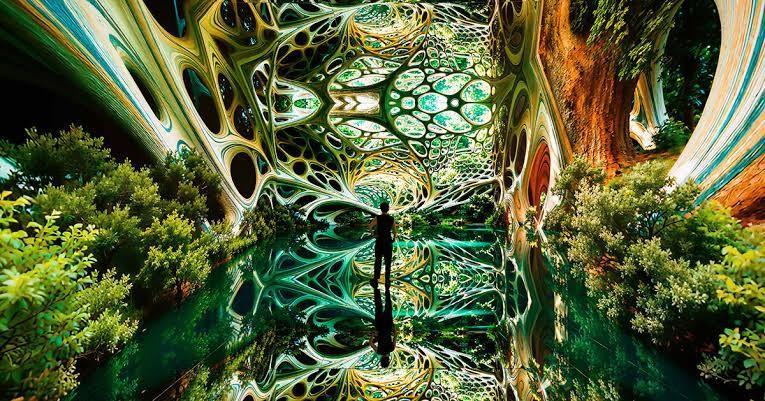
Photo: Refik Anadol Studio, courtesy of DATALAND.
What AI-as-craft-layer looks like in a brief
Four principles, drawn from how Anadol’s studio works and how the better tech-creative studios (Random Studio, Universal Everything, Moment Factory) handle it.
Hide the AI inside fabrication. The visitor should experience a built environment, an object, a moment, not a screen with a prompt field. The AI is the engine of the room, not the room itself. It’s the same logic we used in our AI DJ booth: the AI mixes the music, but what guests see and touch is a hand-fabricated wood build.
Let the AI make the physical thing better, not replace it. Anadol’s installations are physical: projection surfaces, scaled rooms, custom audio architecture. The AI generates content; the craft of making the room work is human.
Train on something specific. The Large Nature Model is built on a defined dataset. That specificity is what earns credibility. An activation that pipes prompts into a generic model doesn’t earn the AI label, it rents it.
Assume the AI will be invisible to most people. If the experience is good without the visitor knowing AI is involved, the AI is doing its job. If the experience needs the visitor to know “this is AI” before it’s interesting, you’ve built a gimmick.
What this means for activation work in 2026
The Anadol-vs-artists fight will keep escalating, and brands that put AI at the visible center of experiences will start drawing the same “second-rate entertainment” criticism. The path that scales past the novelty curve is the one Anadol is on, whatever you think of his work philosophically: AI as a craft layer underneath a fabricated experience. The visitor walks into a room. The room is built by humans. The AI is breathing in the background, making things that couldn’t happen any other way.