The best design brief in Toronto this fall is a parking spot
Park(ing) Day Toronto returns September 18 to 20, 2026, coordinated by Dubbeldam Architecture + Design, with more than 35 activations expected across the GTA and a grant program supporting projects. Participants (studios, artists, nonprofits, brands, residents) transform parking spaces into temporary micro-parks. For designers and brands, it’s the most constrained and most ownable public-design window in the city this fall.
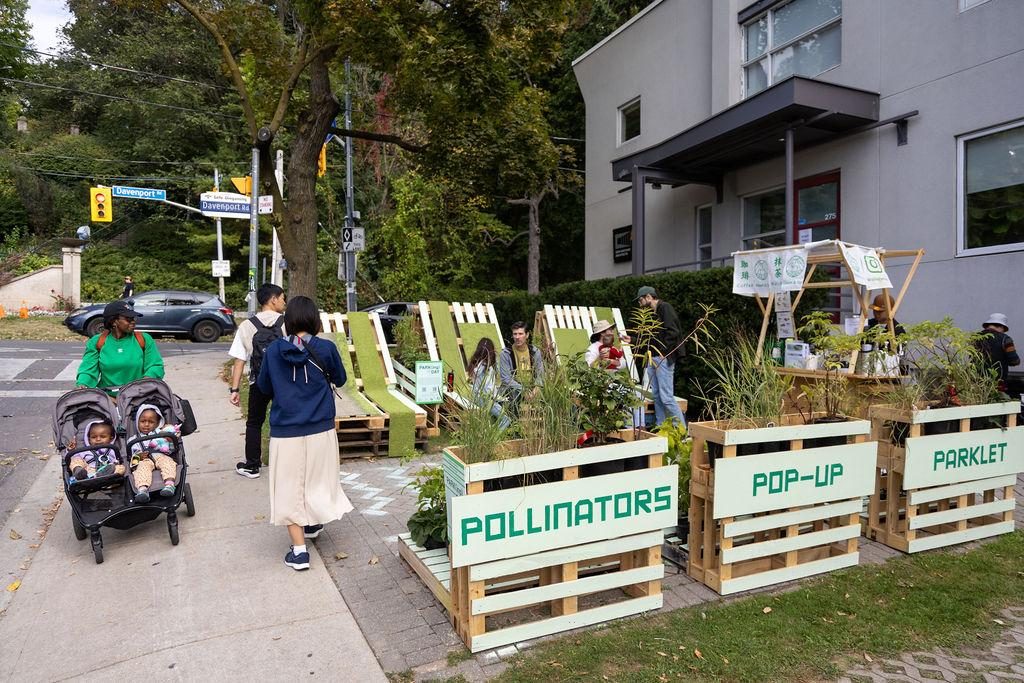
In brief. Park(ing) Day Toronto returns September 18 to 20, 2026, coordinated by Dubbeldam Architecture + Design, with more than 35 activations expected across the GTA and a grant program supporting projects. Participants (studios, artists, nonprofits, brands, residents) transform parking spaces into temporary micro-parks. For designers and brands, it’s the most constrained and most ownable public-design window in the city this fall.
Every September since 2022, Dubbeldam Architecture + Design has coordinated Toronto’s edition of Park(ing) Day, the international event where parking spaces become temporary micro-parks for a weekend. This year’s edition, announced this week for September 18 to 20, is aiming to be the largest yet: more than 35 activations across the GTA, a wide-open participant list spanning design studios, artists, nonprofits, community groups, and residents, and an expanded grant program to back projects.
Here’s why this matters beyond civic feel-good. A parking spot is roughly 2.6 by 5.5 meters, the smallest legitimate footprint in spatial design. The constraint is the brief: no room for six ideas, no budget for spectacle, nowhere to hide weak thinking. Whatever you build must land one idea, survive three days of weather and sidewalk traffic, install in hours, and strike clean. It’s the espresso shot of experiential design, and it’s judged in public by everyone who walks past.
That’s also why the roster of past participants skews toward serious studios. A great micro-park is a portfolio piece with a built-in audience, press coverage from the architecture trades (Azure and Canadian Architect both cover it annually), and a legible demonstration of exactly the skills clients buy: concept clarity, material intelligence, and execution under constraint.
For brands, the window is quieter but real. Park(ing) Day isn’t a sponsorship platform and shouldn’t be treated like one; a logo-wrapped parklet would be tone-deaf. But a genuinely generous piece of public design, built by a brand that makes things, reads differently. The reference point is the Big Goals lesson from Miami this summer: functional craft in public space, timed to a moment, out-earns paid spectacle. A bench people actually want to sit on says more than most OOH buys.
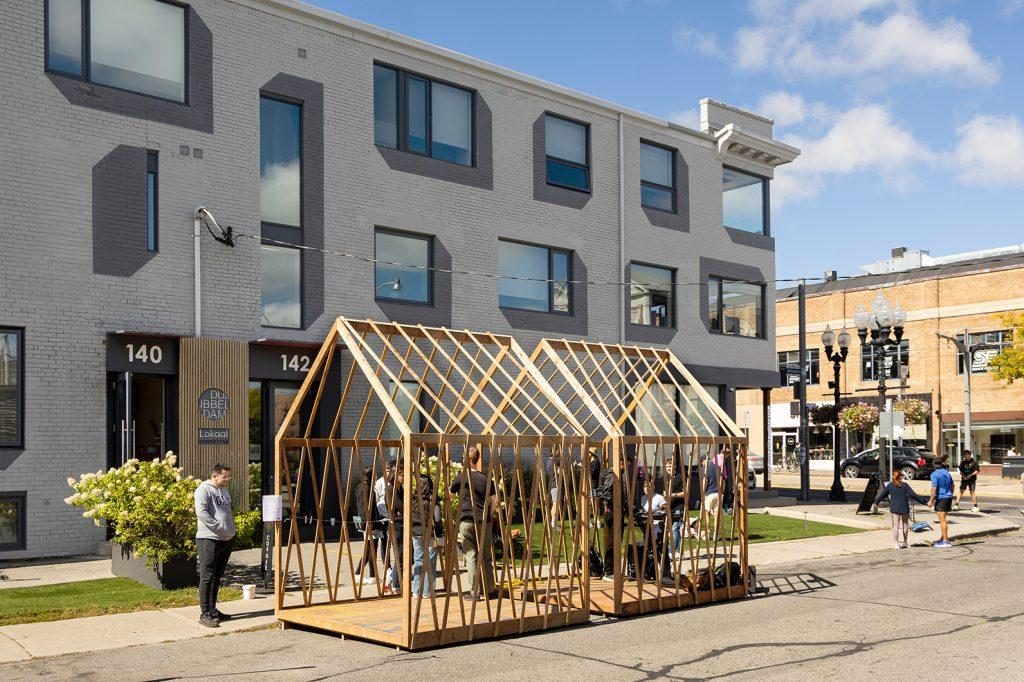
Dubbeldam’s timber-frame parklet outside its own studio, 2025. Photo: Bruno Belli.
The design patterns that historically win these: seating that invites strangers to share, one strong material gesture rather than many small ones, something living, and a reason to linger longer than a photo. The failures are equally predictable: too many messages, precious objects nobody may touch, and builds that look tired by Saturday afternoon.
We’ll say the quiet part: Brience is a Toronto-based custom fabrication and experiential design studio, and we’re looking at this window ourselves. If you’re a brand or a studio that wants to put something worth touching on a Toronto street September 18 to 20, the timeline is short and the footprint is small, which is exactly what makes it a good first build together. Details on hosting are at the organizers’ site; details on building are a conversation with us.
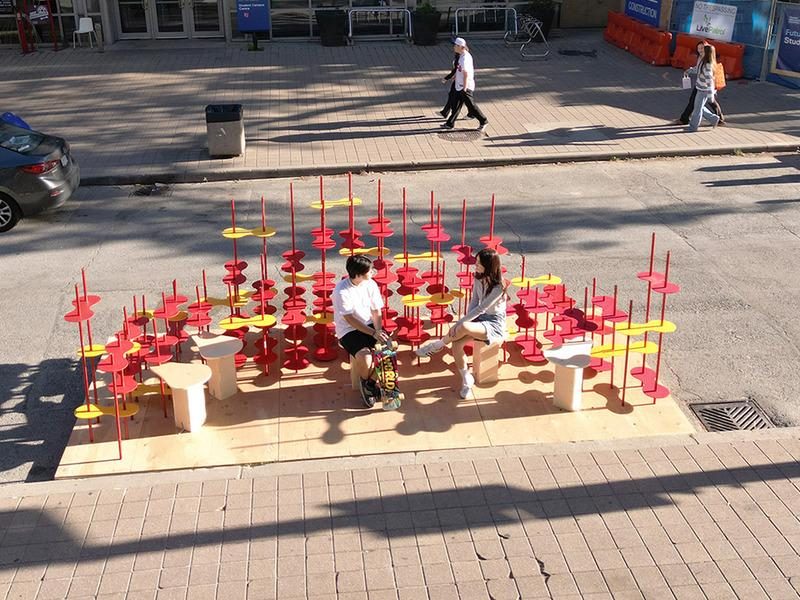
One strong material gesture: a disc-forest parklet from a past edition. Image: Azure.
Sources: Canadian Architect (Aug 5, 2026), Azure (Aug 6, 2026). Park(ing) Day Toronto runs Sept 18 to 20.