 Sign In
 4 min4 min read

Da Vinci’s Robot puts sensors in a motorless exoskeleton and lets motion play the room
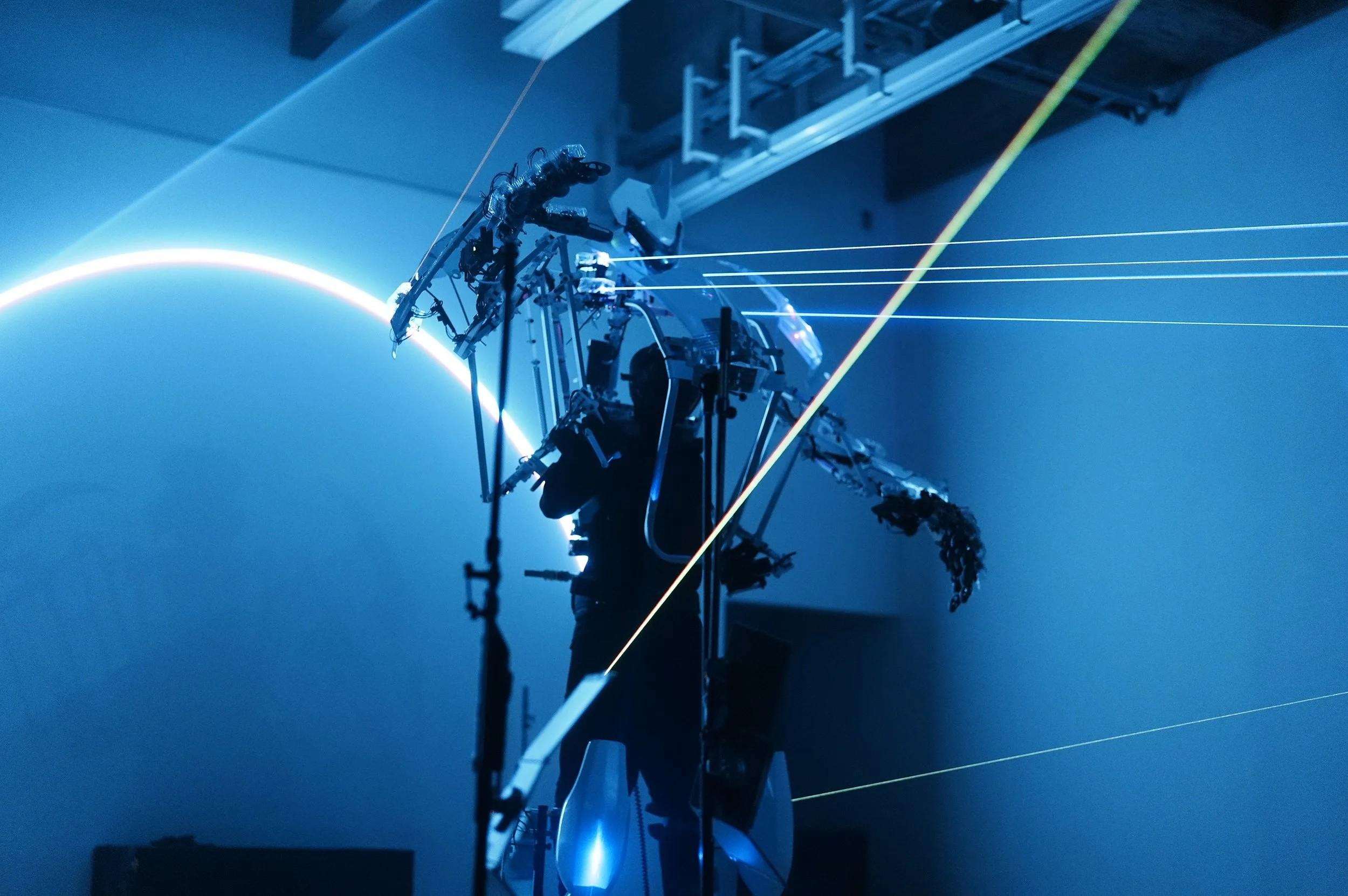
Da Vinci’s Robot, a music theatre work by composer Suguru Goto, puts a performer inside Skeletonics, a human-powered exoskeleton 2.5 to 3 metres tall with no motors. IMU sensors on its joints feed Max/MSP and Goto’s own C++ software, which turn the motion into live sound and drive 20 lasers on the suit and four at the back of the room. It played Tokyo Arts Center’s Tenku Theatre on October 18 and is a 2026 Lumen Prize finalist. The lesson: put the sensors inside the build and let movement be the interface.
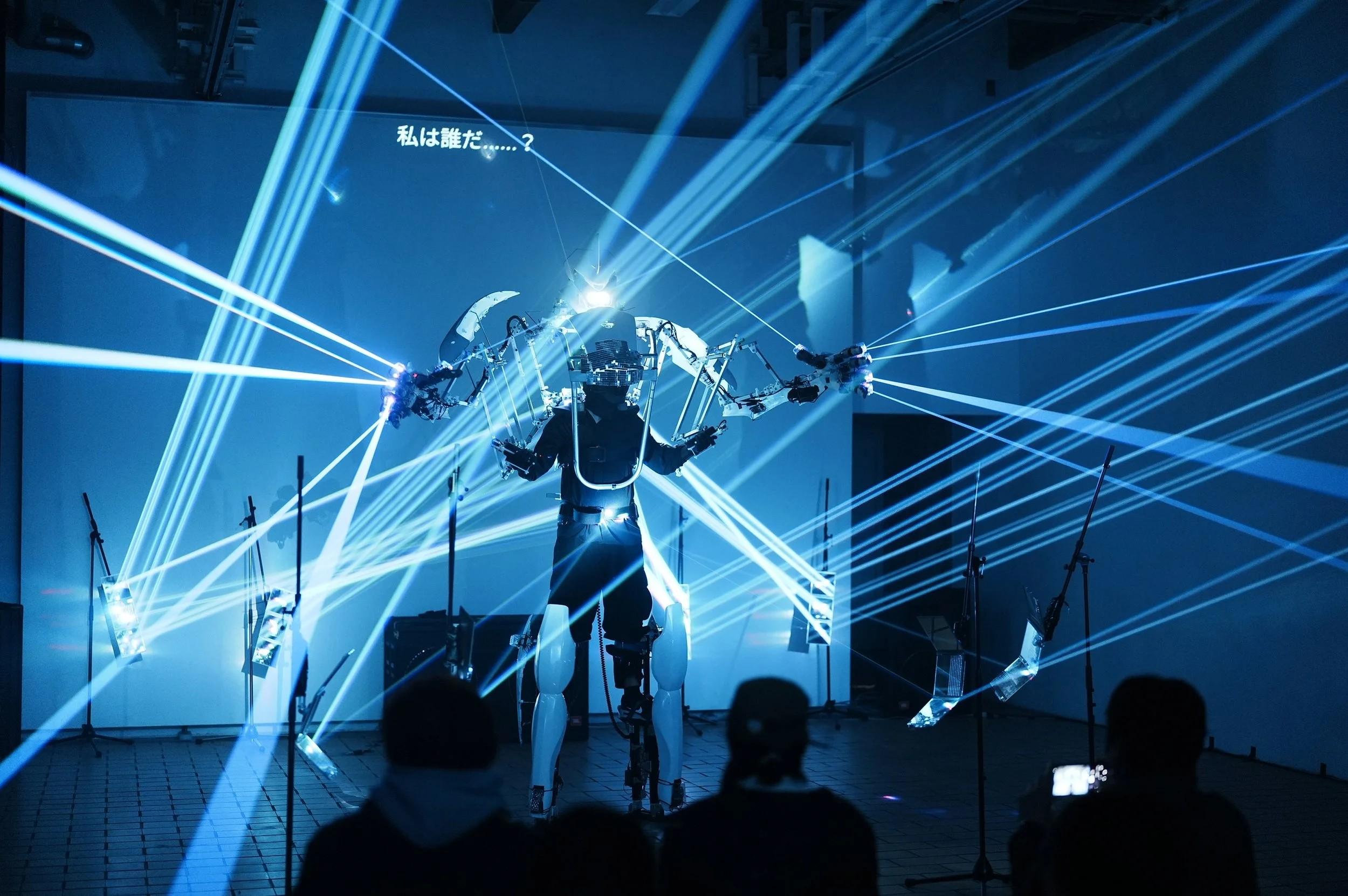
In brief. Da Vinci’s Robot, a music theatre work by composer Suguru Goto, puts a performer inside Skeletonics, a human-powered exoskeleton 2.5 to 3 metres tall with no motors. IMU sensors on its joints feed Max/MSP and Goto’s own C++ software, which turn the motion into live sound and drive 20 lasers on the suit and four at the back of the room. It played Tokyo Arts Center’s Tenku Theatre on October 18 and is a 2026 Lumen Prize finalist. The lesson: put the sensors inside the build and let movement be the interface.
A performer climbs into an aluminum exoskeleton that weighs about 40 kilograms and stands 2.5 to 3 metres tall. Nothing in it has a motor. When the performer lifts an arm, the frame lifts its arm, and the room answers with sound and laser light.
That’s Da Vinci’s Robot, A Will Dwelling in Shadow, a music theatre piece of about 18 minutes by composer and new media artist Suguru Goto. He’s a professor at Tokyo University of the Arts and a former researcher at IRCAM in Paris. CreativeApplications.Net covered the work in October. It played the Tenku Theatre at Tokyo Arts Center on October 18, after a first showing at the university’s ART DX EXPO in March, and it’s a 2026 Lumen Prize finalist for the Experiential Innovation Award.
The starting point is Leonardo da Vinci’s mechanical knight from around 1495, a suit of armour moved by pulleys and cables. Goto’s project page points out what the knight and the exoskeleton share: both run on human strength alone.
In a brand activation, ‘interactive’ often means a touchscreen on a stand. This piece has no display to read and nothing to tap, and the room still answers every move. That’s why we’re paying attention.
 Shop Objects
 Explore our curated brand essentials
How the suit becomes an instrument
The exoskeleton is Skeletonics, developed by Robot Ride, Inc. in Japan. Goto’s lab added the sensing, the software and the light. Here’s the stack, from the project page and CAN:
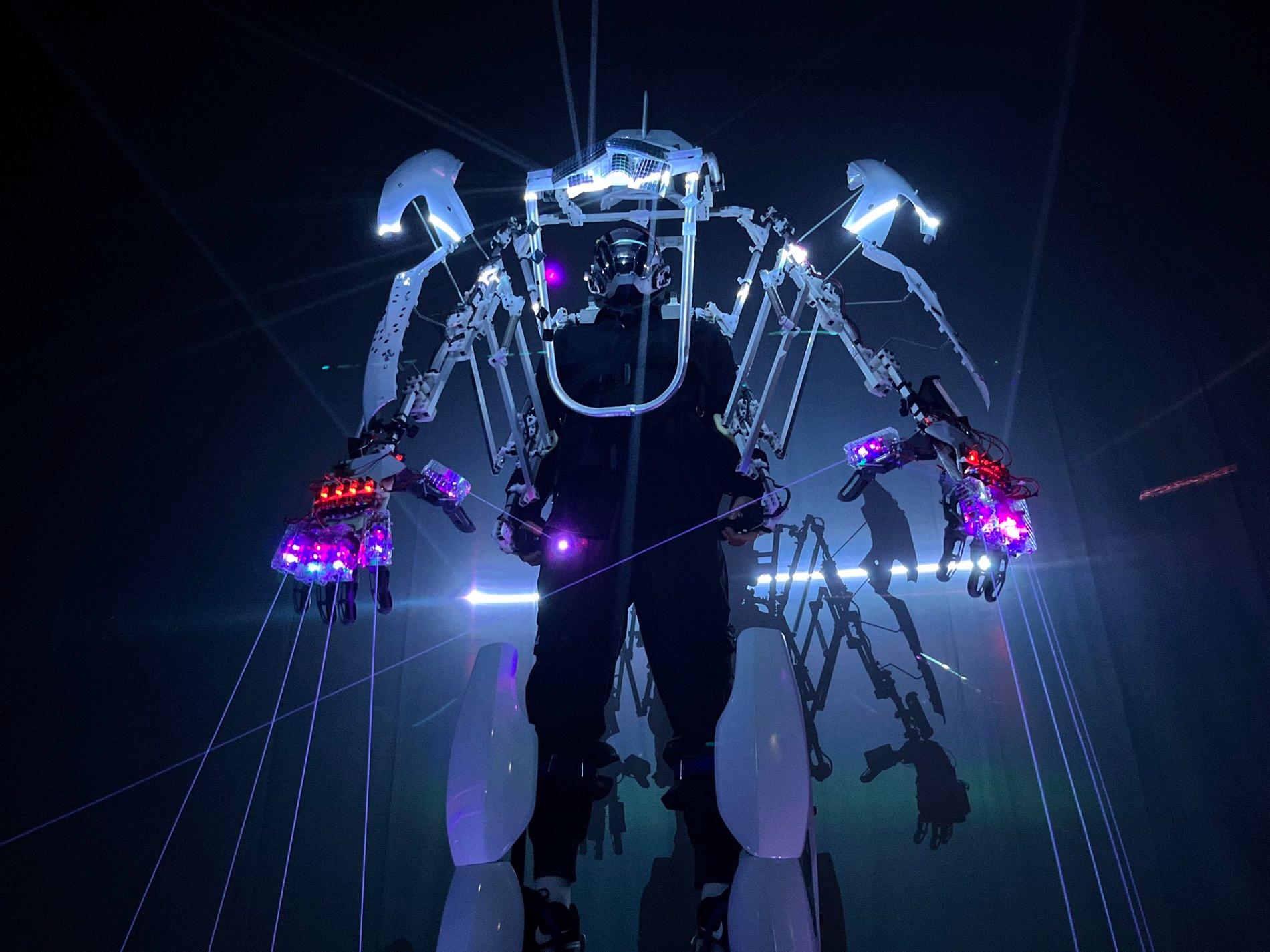
The frame: about 40 kg worn, 16 degrees of freedom, joints at the shoulder, elbow, wrist, waist, knee and ankle. Limbs extend roughly 1:2. No actuators.
The sensors: IMUs on the joints, reading limb orientation and angular velocity and sending the data over Wi-Fi.
The software: Max/MSP, with C++ externals Goto wrote himself for motion classification and real-time synthesis.
The light: 20 small lasers mounted on the suit, four large laser projectors at the back of the room, and eight mirrors that bounce the beams onto the performer and throw a giant shadow on a rear screen.
Because the sound and the light come from the same motion data, they stay in sync. The suit weighs about 40 kg, and that shows in every move.

 Get a QuoteRequest your personalized project
The body is the interface
Nobody in the audience touches anything, and the performer doesn’t press a button. CAN puts it simply: the structure’s motion “is sensed and becomes sound in real time.” The performer’s body is the controller, and the build is what people watch.
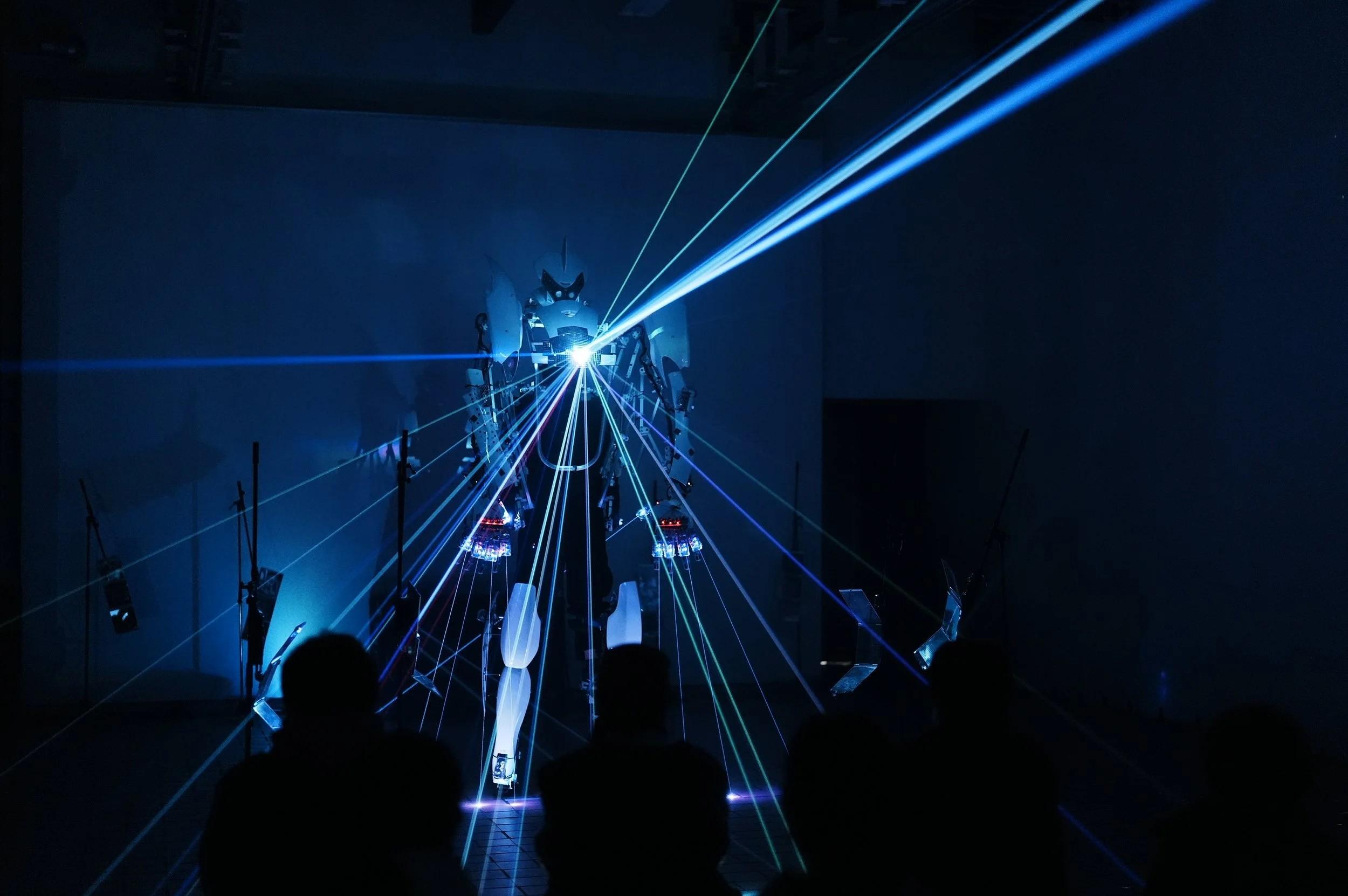
Goto’s page says the laser system calibrates itself to the size and shape of each venue. If you tour work, that’s the detail to notice.
The two main sources differ on one point. CAN says nothing is pre-recorded, while Goto’s own page lists recorded samples alongside AI sound generation. Either way, the sound follows the performer’s motion live.
Tech inside the build
Brience is a Toronto-based custom fabrication and experiential design studio, and this is close to how we think about technology in a physical piece. A lot of interactive briefs still start with a screen. Goto’s suit drops the screen: the object itself is the input.
You don’t need an exoskeleton to use the idea. A lever, a seat, a door or a drum can carry a motion sensor, and the response can be light and sound in the room. Plan the wireless link and the calibration early, because a crowded venue is hard on both.
Get a QuoteRequest your personalized projectIf your brief says “interactive” and you’d rather not answer it with a touchscreen, let’s talk about the build.
Sources: CreativeApplications.Net, “Da Vinci’s Robot: A non-powered exoskeleton whose motion becomes sound” (October 2026); Suguru Goto, Da Vinci’s Robot project page (2026); The Lumen Prize, 2026 Experiential Innovation Award finalists (2026).